
Building Marketing Associations Fit for an AI-Enabled Future
03 Nov 2026
At the EMC Forum 2026, representatives of EMC's member associations and other associations across Europe and Canada joined marketing experts and award-winning marketers to explore how the associations of tomorrow can stay useful, commercially confident and deeply human in an AI-enabled profession.
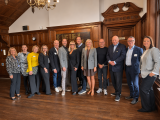
On 29 October, the European Marketing Confederation (EMC) brought representatives of EMC's member associations, colleagues from other associations across Europe and Canada, and business guests together at the Chartered Institute of Marketing's Moor Hall in Cookham.
The Forum was held in person and online, so that a wider professional community could take part in the discussion.
Across the programme, one conclusion kept returning. Technology matters, but it is not the strategy. The associations that will matter most are those that turn new tools into confidence, capability, trusted peer exchange and measurable member value.
Technology matters, but it is not the strategy.
The human case for AI
Gemma Butler, a marketing communications consultant with the Chartered Institute of Marketing in the United Kingdom, opened the Forum with a reminder that AI adoption is moving faster than organisational readiness. Research shared at the event, drawing on more than 2,000 marketers and 500 marketing decision makers, found that nearly half of decision makers had no formal AI skills programme or strategy despite implementation already being under way. Familiar gaps in data and analytics, proving return on investment, and data privacy remain just as important in the AI era.
Her challenge was to move beyond a race for the newest tool. The future is not a choice between people or AI, but people plus AI: using technology to improve effectiveness while protecting judgement, creativity, brand distinctiveness and trust. For professional bodies, that creates a clear mandate to help marketers build practical literacy, sound governance and the confidence to make better decisions.
CMOs need commercial confidence and peer connection
In conversation with Dr Ralf Strauss, Pete Markey, an award-winning CMO from the United Kingdom and Chief Communications and Marketing Officer at the University of Nottingham, former CMO of Boots UK and President of ISBA, described the contemporary marketing leader as part artist, part scientist and a committed advocate for the function. Customer obsession, commercial understanding and creative ambition must now sit together. His experience across retail, financial services and higher education gave the discussion a valuable perspective on what changes across sectors - and what never does.
Markey's message was practical. Earn permission for longer-term transformation by delivering early value; align marketing with finance and IT through shared goals; use a credible fact base for difficult budget conversations; and make change tangible through advocates, milestones and a clear story. He also offered a timely challenge to associations: their greatest value is not adding more material to already full inboxes, but creating the peer connection and candid conversation that make a demanding CMO role feel less isolated.
Transformation needs a business mindset
In Hungary, award-winning CMO Zsófia Bánhegyi, Chief Executive Officer of the Hungarian Marketing Association, MMSZ, shared the Forum's most striking association-transformation case. A deliberate business mindset helped turn a small, financially pressured organisation into a stronger professional voice. From 29 company members in 2017, MMSZ has grown to almost 300 company members and now reaches more than 110,000 professionals every week through its media channel. The progress was built on trusted knowledge, flagship events, an independent content platform and advocacy for marketing at business and policy level.
The lesson was clear: relevance is not achieved by simply adding activity. It comes from a clear member promise, commercially disciplined operations and the courage to position marketing as a driver of business and societal value.
Shane McGonigle, Chief Executive Officer of the Marketing Institute of Ireland, reinforced the same principle from an Irish perspective. His MII case showed how awards, learning, recognition and networking can operate as one year-round value proposition rather than a series of isolated activities. The MII Awards work not only as a celebration, but as a platform for professional visibility, credible case studies and ongoing member engagement.
His broader argument was commercially direct: professional purpose and financial discipline are not competing ideas. Strong revenue models make it possible to invest in people, systems and a more valuable member experience.
Boards and services can be designed not inherited
In Lithuania, Neringa Petrauskaitė, Chair of the British Chamber of Commerce in Lithuania and Partner at We Are Marketing, challenged associations to build the board their next chapter needs, rather than simply fill vacant seats. Her governance case began with future direction, then mapped the capabilities required, the time and contribution expected, and the accountability that follows. A board selected this way can bring the relevant networks, influence and willingness to act when an organisation needs to change.
Sanna Laakkio, Chief Executive Officer of MARK, the Association of Finnish Marketers, offered another practical example of an association moving closer to a business problem. MARK's Partner Search begins with a company's growth challenge in ordinary business language, then helps it find suitable marketing expertise through traditional and AI-supported search. The innovation is not only the technology. It is the service design: making marketing expertise easier for a CEO to understand, find and buy.
Systems should serve the member journey
Rūta Gaudiešienė, Chair of the Board of LiMA, the Lithuanian Marketing Association, and Senior Partner at Civitta in Lithuania, offered a useful corrective to technology-first enthusiasm. Separate ticketing, newsletter, membership and website tools had created manual work, fragmented data and a limited view of the member journey. LiMA has since moved towards an integrated platform linking website, CRM, membership, events and marketing automation. The association estimates that this has already saved 700 hours of work and created room to grow without adding equivalent workload.
The harder lessons were equally valuable: start with a prototype rooted in the member journey; budget for internal time as well as technology; consolidate processes before automating them; and clean data before expecting AI to create value. Personalisation and prediction are powerful, but only once the underlying foundations are reliable.
A European agenda built on maturity not hype
Dr Ralf Strauss, Chairman of the European Marketing Confederation in Germany, outlined the next European Marketing Agenda, which will map AI maturity across strategy, leadership, use cases, data infrastructure, skills and organisational change. The ambition is not simply to compare countries. It is to give national associations a clearer picture of what their members need, so that support can be targeted to real gaps – whether in data security, process design, customer experience, skills or implementation.
The closing roundtable turned this into a shared European opportunity. Participants saw strong potential in independent guidance for senior leaders, honest exchange on both successful and unsuccessful implementations, peer learning, credible expert voices and coordinated webinars that translate research into practical choices. Generic training alone is not the answer. Associations can add most value by convening trust, curating evidence and helping members apply what matters in their own organisation.
What the Forum made clear
EMC Forum 2026 did not claim that there is a single formula for the future. It offered something more useful: a working view of how associations can remain essential. Relevance must be earned through better governance, commercial discipline, capable systems, human connection and the willingness to change the way we work. As AI reshapes marketing's operating model, EMC and its member associations have an opportunity to become capable, trusted partners in that change - for their members, the profession and the businesses it serves.